


Your Health is the Ultimate Compounding Asset: Why Your Wealth Means Nothing Without It

When we talk about compounding on Grad Rags to Riches, the conversation usually focuses on low cost global index funds, tax wrappers like ISAs and Pensions, and the magic of compound interest over 30 years.
We preach disciplined consistency: setting up a Direct Debit into your ISA every single month, ignoring the noise, and letting small, unsexy habits build long-term freedom.
But there is another asset class operating under the same mathematical laws - one that most ambitious wealth-builders completely ignore until it’s too late.
Your health.
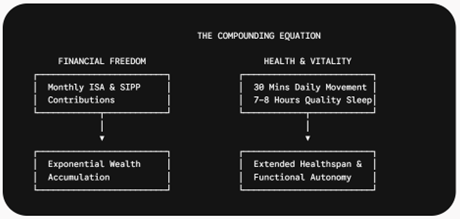
Just as investing £100 a month into a low-cost FTSE Global All Cap fund in your twenties compounds into financial independence, the daily lifestyle choices you make today - or fail to make - are compounding silently in the background.
Lifespan vs Healthspan: The Metric That Actually Matters
In personal finance, we care about real purchasing power, not just nominal balances. A pot of £2,000,000 is useless if hyperinflation has made a loaf of bread cost £50,000.
In medicine and longevity, a similar distinction exists between two key terms:
Lifespan: The total number of years you are alive.
Healthspan: The period of your life spent free from chronic disease, disability, and severe cognitive or physical decline.
Most traditional retirement planning focuses exclusively on funding your lifespan. But if you sacrifice your body to hit FIRE (Financial Independence Retire Early) at 45, only to spend your 50s and 60s dealing with preventable cardiovascular disease, chronic pain, or metabolic dysfunction, the internal rate of return on your life plummets.
Data shows that lifestyle interventions - regular physical activity, solid sleep, quality nutrition, and moderate alcohol intake - can extend healthspan by 12 to 14 years.
4 Index Fund Level Interventions for Your Health
In the world of finance, stock picking and market timing are low-probability bets. The "index fund consensus" is simple: buy low-cost global index funds and hold them long term.
When it comes to health, the noise can be equally overwhelming: ice baths, obscure supplements, hyper-specific diets, and fringe biohacks. But if we filter for index fund-level medical consensus, four core pillars drive the vast majority of outcomes:

1. Exercise (Cardiorespiratory Fitness & Strength)
If exercise were an ETF, it would be the highest-performing asset class in human history.
Cardiorespiratory Fitness (VO2 Max): Studies published in the Journal of the American Medical Association show that having below-average cardiorespiratory fitness carries an all-cause mortality risk comparable to, or worse than, smoking cigarettes.
Muscle Mass (Sarcopenia): We naturally begin losing muscle mass in our 30s. Muscle functions like a health pension pot: building a higher peak of muscle mass and bone density early in life gives you a larger "reserve balance" to draw down safely as you age, preventing frailty and loss of independence.
2. Sleep
Chronic sleep deprivation (fewer than 6 hours per night) is directly correlated with higher risks of cardiovascular events, impaired cognitive performance, and poor metabolic health.
Sleep is the biological equivalent of portfolio rebalancing; it clears neural waste, repairs tissue, and resets hormone levels.
3. Nutrition
You don't need an overly dogmatic diet. The core fundamentals backed by broad evidence are straight out of the personal finance playbook: avoid toxic inputs (excessive alcohol, smoking, heavily processed foods), focus on whole foods with adequate protein and fibre, and keep blood sugar spikes manageable. The best diet is simply the one you can stick to consistently over decades.
4. Mental Health & Social Relationships
Longitudinal research, including the long-running Harvard Study of Adult Development, consistently demonstrates that strong social relationships are among the single best predictors of long-term health and happiness.
Investing time and capital into maintaining deep connections with friends and family pays compound interest in life satisfaction.
Author Daniel Pink, in his research on human regret, identifies what he calls Foundation Regrets: failures in foresight, prudence, and discipline that compound into massive negative consequences over time. Finance and health generate the vast majority of foundation regrets:
"I wish I had started putting money into an ISA or pension in my twenties."
"I wish I had taken better care of my body when I was younger."
Because both systems involve massive time lags, you cannot easily "catch up" at age 55.
Trying to build functional muscle or reverse decades of arterial plaque in your late fifties is the physical equivalent of trying to build a £1,000,000 pension starting at age 62. The compounding window has already closed on the most potent years.
Practical Takeaways for Your Wealth & Health Plan
Budget for Health Like a Fixed Direct Debit: Just as your monthly ISA transfer leaves your bank account automatically on the 1st of the month, schedule your workouts, sleep routine, and meal planning.
Use Money to Buy Back Time for Health: If spending money on a gym membership, a bicycle, time-saving convenience options, or proper walking kit enables regular exercise and better eating, that is a high-ROI financial allocation.
Protect Your Primary Wealth Generator: Your ability to earn, invest, and enjoy your money depends entirely on your physical wellbeing. Treat regular check-ups and preventative health as essential maintenance for your most valuable asset. Address minor physiological or structural red flags early, before they compound into chronic issues.


Comments